How to reply to every lead in five minutes when you're the only one there.
You are on a ladder, under a sink, mid-appointment, or driving. The lead does not care. Here is the five-minute reply window in plain terms, five texts you can copy today, and the ladder that runs after them.
Reply inside five minutes, but split the reply in two. An acknowledgement goes out automatically the second a call is missed or a form is filled, saying exactly when you'll call back. The answer comes from you, when you're off the job. Most work is lost in the silence before the acknowledgement, not in the wait for the answer.
Every solo owner I talk to has the same picture in their head: a lead comes in, and somewhere in the next hour they are supposed to become a different person: one who checks their phone between jobs, remembers the name, and calls back before dinner. That person does not exist. You are working.
So the fix cannot be "try harder." It has to be a change in what a reply is.
What the research actually says about the window.
Two studies get quoted constantly. Here is what they found, without the scare framing.
The Lead Response Management study (Dr. James Oldroyd, 2007) looked at millions of inbound leads and found the odds of qualifying a lead fell off a cliff between a five-minute reply and a thirty-minute reply, roughly a 21-fold difference. Harvard Business Review ran a similar analysis in 2011 across 2,241 US companies and found firms that responded within an hour were about seven times more likely to have a meaningful conversation with a decision-maker than firms that waited just one hour longer, and about sixty times more likely than firms that waited a day.
Both studies are old enough to have grandchildren, and both keep getting re-confirmed because the reason behind them hasn't changed: a person looking for a plumber at 7pm is not shopping, they are solving. They will take the first competent answer that arrives. Being the first competent answer is a scheduling problem, not a sales problem.
Split the reply in two.
Here is the move that makes five minutes possible for one person. Stop treating "reply" as one thing. It's two:
| The acknowledgement | The answer | |
|---|---|---|
| Job | Stop them shopping. Prove a human exists. | Price, availability, the actual conversation. |
| Deadline | Under 5 minutes | Same day |
| Who does it | Never you. Automatic, every time. | You, when you're free. |
| Length | Two sentences | As long as it needs |
| Must include | Your name, and when you'll call | A specific next step or time |
Once you separate them, the impossible standard disappears. You are not promising to be reachable in five minutes. You are promising to be accounted for in five minutes, which a phone can do while you're holding a wrench.
Five replies you can copy today.
Swap the bracketed bits for your own words. Keep them short. Long automatic messages read as automatic.
Naming a real time is the whole trick. "ASAP" is what everyone says, so it reads as nothing.
"I'm not ignoring you" does more work than any professional phrasing. It answers the thing they were actually wondering.
The closing question keeps them typing, which is how you find out how serious they are before you spend an hour on a quote.
Giving them permission to say no is what gets the reply. Most silence is embarrassment about price, not disinterest.
This one gets replies more often than any of the others. Say it and mean it.
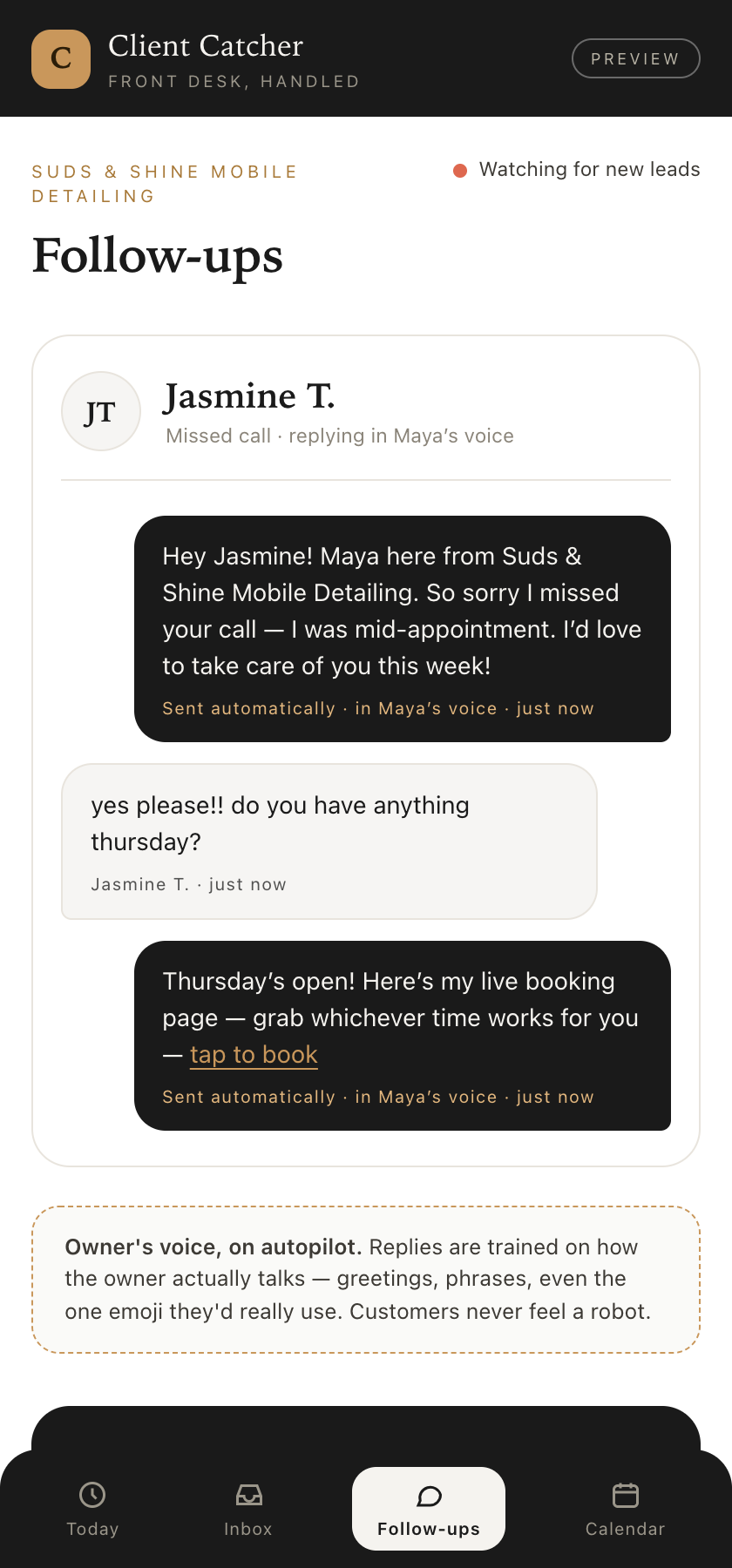
That's the same two-part shape on a screen: an acknowledgement that went out without anybody typing it, and a conversation that stayed alive long enough for a booking link to land. The owner was mid-appointment for all of it.
The ladder that runs after the first reply.
One reply is not follow-up. Follow-up is a small number of touches on a fixed schedule, and then a clean stop. Four to five, over about a week:
| When | What goes out | Channel | Who sends |
|---|---|---|---|
| 0 to 5 min | Acknowledgement · script 01, 02 or 03 | Text | Automatic |
| Same day | The real answer, price or times | Call, then text | You |
| Day 2 | Quote nudge · script 04 | Text | Automatic |
| Day 4 | One useful thing. No ask. | Text or email | Automatic |
| Day 7 | Close-out · script 05 | Text | Automatic |
| Booked at any point | Ladder stops. Reminders start. | , | Automatic |
That last row is the one people forget, and it is the one that costs you. Nothing sours a booked customer faster than getting chased for a job they already said yes to.
What "one useful thing" means on day four.
- A photo of a similar job you finished, "this is the same fix, took a morning"
- The honest thing they should check themselves before paying anyone
- What it costs if they wait until it gets worse, stated plainly, no drama
- A slot that just opened up, if one genuinely did
How to build this today for free.
About an hour of setup. No subscription. Do this before you consider paying anyone, including me.
- Turn on missed-call auto-text. Most business phone apps and both major phone systems can send a text automatically when a call goes unanswered. Paste script 01 in.
- Write a second version for after hours and switch between them manually at the end of the day, or set a schedule if your phone allows it. Script 02.
- Make your form send an instant confirmation. Every free form tool does this. Paste script 03 into the auto-response.
- Save scripts 04 and 05 as text shortcuts on your phone. Type a short code, the whole message appears.
- Put two recurring reminders in your calendar, one mid-morning and one late afternoon, that just say "who's waiting on me?"
- Keep one list of everyone who's mid-ladder, with a date column. A spreadsheet is fine. The list is what makes the ladder real.
It breaks at step 6, always. The automatic parts run fine. It's the remembering that fails. Day two arrives while you're on a job, day four never happens, and the day-seven close-out that would have won the work never goes out. Free automation can send a message. It can't know who already answered, who's booked, and who's been sitting untouched since Tuesday.
That's the difference between a phone trick and a system: a system holds the list, moves people along it, and shuts up the moment they book.
Questions owners ask about this.
Doesn't an automatic text feel impersonal?
What if I reply fast and they still don't book?
How many follow-ups is too many?
I already miss calls all day. Where do I start?
Does this work for booked appointments too?
- Oldroyd, J. B., Lead Response Management Study, 2007. Analysis of inbound lead response timing across millions of leads.
- Harvard Business Review, "The Short Life of Online Sales Leads", March 2011. Study of 2,241 US companies' lead response times.
You close up at five and nothing is sitting there waiting for you.
SynKasa Grow runs the response and follow-up above. Missed calls get an answer, qualified jobs reach the calendar, and the chasing stops when someone books.
$1,500 once, with optional care at $222 a month. Live in 7 days, or you don't pay.